
Best Pool Test Kits
We compare seven pool test kits and test strips from Taylor, AquaChek, LaMotte, and HTH, with CDC guidance on accuracy, target levels, and false zero readings.
 Updated October 30, 2026
The best pool test kit is the one that measures the numbers your pool depends on, accurately enough to act on. Our Best Overall pick, the LaMotte 3-Way Test Strips (2976), meets the Best Overall criteria set out in How We Chose and reads free chlorine from 0 to 10 ppm, total alkalinity, and pH, per LaMotte’s product page. The CDC’s home pool guidance says a DPD test kit gives the most accurate chlorine and pH results and that test strips are less accurate than a DPD kit, so pair quick strips with a DPD kit such as the Taylor K-1004 for the readings you act on. This guide compares seven test kits and test strips from Taylor, AquaChek, LaMotte, and HTH.
This guide is general product information, not medical or chemical-handling advice. Follow the directions on your test kit and on every pool chemical label. For example, the EPA-registered label of one chlorinating tablet product (EPA Reg. No. 3432-24) is marked DANGER, warns that the product is corrosive, causes irreversible eye damage and skin burns, may be fatal if absorbed through skin or if inhaled, and is harmful if swallowed, calls for goggles or a face shield, protective clothing, and rubber gloves, says to keep it out of reach of children, says to mix it only with water, and says not to mix it with any other kind of chlorine because an explosion could result. Read the label of every pool chemical you own before you use it. If someone swallows a reagent or a pool chemical, contact Poison Control at 1-800-222-1222 or use its online tool.
We earn a commission from qualifying purchases made through links on this page. Commissions never affect our rankings or BackyardPoolLab Scores.
Our Top Picks at a Glance
- Best Overall: LaMotte 3-Way Test Strips (2976), dip-and-read strips for free chlorine (0 to 10 ppm), total alkalinity, and pH, per LaMotte. They meet the Best Overall criteria in How We Chose.
- Best DPD Drop Kit: Taylor K-1004 6-Way Test Kit, the only kit here whose maker lists the DPD method, for free and total chlorine, bromine, pH, acid demand, and total alkalinity.
- Most Readings per Strip: AquaChek 7-Way Test Strips, which cover seven readings per strip, including cyanuric acid and total hardness, per the listing.
- Best Salt Add-On: Taylor K-1766 Sodium Chloride Test Kit, the only kit here that measures salt, for owners of salt water pools.
The full list also includes the LaMotte 5-Way Test Strips (2977), HTH 6-Way Test Strips, and HTH 6-Way Test Kit. All seven are compared in the cards and table below.
Our ranking reflects our editorial assessment of manufacturer and listing specifications and owner ratings. The BackyardPoolLab Score is shown for reference and does not set the order; see How We Review for how it is calculated.
| Award | Product | BackyardPoolLab Score About BackyardPoolLab ScoreThe BackyardPoolLab Score is calculated with the published method on our How We Review page. Learn more › | |
|---|---|---|---|
| Best Overall |
 LaMotte 3-Way Pool Strips (2976) |
9.1/10 | Buy |
| Best DPD Drop Kit |
 Taylor K-1004 6-Way DPD Pool Kit |
8.6/10 | Buy |
| Most Readings per Strip |
 AquaChek 7-Way Pool and Spa Strips |
8.8/10 | Buy |
 LaMotte 5-Way Pool and Spa Strips (2977) |
8.6/10 | Buy | |
 HTH 6-Way Pool Strips |
8.4/10 | Buy | |
 HTH 6-Way Pool Water Kit |
8.3/10 | Buy | |
| Best Salt Add-On |
 Taylor K-1766 Sodium Chloride Kit |
8.6/10 | Buy |
LaMotte 3-Way Pool Strips (2976)
Dip-and-read strips for free chlorine (0 to 10 ppm), bromine, total alkalinity, and pH 6.2 to 9.0, per LaMotte. 50 strips in a bottle with a desiccant liner against moisture and UV light.
Pros
- Free chlorine range up to 10 ppm, per LaMotte
- Instant dip-and-read results, per LaMotte
- Moisture- and UV-protective bottle liner
Cons
- No total chlorine, cyanuric acid, or hardness reading
- CDC says strips are less accurate than a DPD kit
- Sparse product detail on the listing
Taylor K-1004 6-Way DPD Pool Kit
DPD drop kit for free and total chlorine, bromine, pH, acid demand, and total alkalinity, per Taylor. The listing describes a storage case, comparator, 8 reagents, and dosage charts on the instruction card.
Pros
- DPD method for free and total chlorine, per Taylor
- Separate free and total chlorine readings
- Replacement reagents sold separately, per the listing
- Dosage charts on the card; follow the label of the chemical you add
Cons
- No cyanuric acid or calcium hardness reading
- Chlorine scale tops out at 5 ppm, per Taylor
- Slower than dipping a strip
AquaChek 7-Way Pool and Spa Strips
Strips that read pH, total and free chlorine, bromine, alkalinity, total hardness, and cyanuric acid, according to the listing. Dip, wait 15 seconds, and match the color chart on the bottle; 100 strips per bottle.
Pros
- Seven readings per strip, per the listing
- Includes cyanuric acid and total hardness
- 100 strips per bottle
Cons
- CDC says strips are less accurate than a DPD kit
- Listing suggests checking less often than the CDC advises
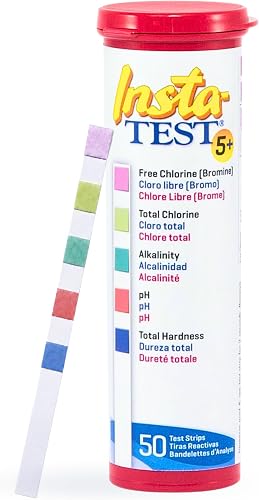
LaMotte 5-Way Pool and Spa Strips (2977)
Strips for free and total chlorine, bromine, alkalinity, pH, and total hardness, according to the listing. Dip and swirl three times; 50 strips per bottle.
Pros
- Free and total chlorine on one strip, per the listing
- Adds total hardness to the basic readings
- Simple dip-and-swirl use
Cons
- No cyanuric acid reading in the listing
- CDC says strips are less accurate than a DPD kit
HTH 6-Way Pool Strips
Strips for chlorine, bromine, pH, alkalinity, calcium hardness, and cyanuric acid, per the listing, for chlorine, bromine, and salt water pools. The listing says you can text a photo of results to HTH for instructions.
Pros
- Cyanuric acid and calcium hardness on one strip
- Photo-based care instructions from HTH, per the listing
- Directions printed on the bottle
Cons
- Listing does not say if the chlorine pad reads free or total
- 30 strips per bottle
- Listing suggests weekly checks, less often than CDC advice
HTH 6-Way Pool Water Kit
Kit with solution and strips for up to 100 uses, per the listing, reading total chlorine, bromine, pH, total alkalinity, total hardness, and cyanuric acid. Store in a cool, dark place and replace yearly, per the listing.
Pros
- Cyanuric acid and total hardness included
- Up to 100 uses per kit, per the listing
Cons
- Listing names total chlorine, not free chlorine
- Listing suggests weekly checks, less often than CDC advice
- Replace yearly, per the listing
Taylor K-1766 Sodium Chloride Kit
Salt-only drop kit for salt water pools: 1 drop equals 200 ppm sodium chloride, per Taylor. The listing says it includes a silver nitrate reagent, a chromate indicator, a glass tube, and a storage box.
Pros
- Measures salt level for chlorine generators
- Simple drop count, per Taylor
Cons
- No chlorine, pH, or alkalinity reading
- Two reagents to store and replace
Pool Test Kit Comparison Table
What each product reads comes from the maker’s product page where we could open one (Taylor, LaMotte 2976) and from the Amazon listing otherwise. “Not listed” means neither source names that reading.
| Product | Type | Free chlorine | Total chlorine | pH | Alkalinity | Hardness | Cyanuric acid | Salt |
|---|---|---|---|---|---|---|---|---|
| LaMotte 3-Way (2976) | Strips, 50 | Yes (0 to 10 ppm) | Not listed | Yes (6.2 to 9.0) | Yes (0 to 240 ppm) | Not listed | Not listed | Not listed |
| Taylor K-1004 | DPD drop kit | Yes (0.5 to 5 ppm) | Yes | Yes (6.8 to 8.2) | Yes | Not listed | Not listed | Not listed |
| AquaChek 7-Way | Strips, 100 | Yes | Yes | Yes | Yes | Total hardness | Yes | Not listed |
| LaMotte 5-Way (2977) | Strips, 50 | Yes | Yes | Yes | Yes | Total hardness | Not listed | Not listed |
| HTH 6-Way strips | Strips, 30 | “Chlorine” (type not stated) | Not stated | Yes | Yes | Calcium hardness | Yes | Not listed |
| HTH 6-Way kit | Strips and solution, up to 100 uses | Not listed | Yes | Yes | Yes | Total hardness | Yes | Not listed |
| Taylor K-1766 | Drop kit, salt only | Not listed | Not listed | Not listed | Not listed | Not listed | Not listed | Yes (1 drop = 200 ppm) |
How We Chose
We do not run our own product trials. Our picks draw on maker product pages, the Amazon listings, CDC guidance, and Amazon owner ratings. Owner ratings set the base of each product’s BackyardPoolLab Score, calculated with the method on our How We Review page. We started from the pool test kits and test strips sold new on Amazon in the US, then kept only listings that met every rule below.
- Makers in this guide. The picks come from Taylor, AquaChek, LaMotte, and HTH. Listings whose manufacturer field named a company we could not tie to the brand were dropped.
- Owner ratings above our floor. Every pick meets our minimum Amazon owner rating and a minimum number of ratings. We do not print the figures because Amazon data changes daily.
- New units available. We dropped a listing that had no new units for sale when we checked, and refill-only reagent packs.
- Best Overall criteria. The Best Overall label goes only to a pick from a maker we cover that clears a higher owner-rating bar than our general floor, with a minimum number of ratings. Among picks that clear it, owner rating decides; if that is tied, we favor the kit whose maker specs list free and combined chlorine, pH, alkalinity, and cyanuric acid.
The order below is our editorial judgment, not a sort by score: the Best Overall pick first, then the DPD drop kit, then the remaining strips and kits, and the salt-only kit last because it is an add-on rather than a complete kit.
The Pool Test Kits We Recommend
1. LaMotte 3-Way Test Strips (2976)
Who it suits: owners who want a fast strip for the daily free chlorine, alkalinity, and pH check, for example on a busy summer weekend, and who keep a DPD drop kit for the readings they act on.
What stands out: LaMotte’s product page for order code 2976 lists free chlorine 0 to 10 ppm, bromine 0 to 20 ppm, total alkalinity 0 to 240 ppm, and pH 6.2 to 9.0. It describes a dip-and-read strip with instant results, 50 strips per bottle, and a bottle with a molded desiccant liner that protects the strips from moisture and UV light. The Amazon listing title names free chlorine, alkalinity, and pH.
- Pro: meets the Best Overall criteria in How We Chose.
- Pro: free chlorine reading up to 10 ppm, per LaMotte, twice the top of the K-1004 chlorine scale.
- Pro: moisture- and UV-protective bottle liner, per LaMotte.
- Con: no total chlorine, cyanuric acid, or hardness reading.
- Con: strips are less accurate than a DPD kit, per the CDC.
- Con: the Amazon listing gives very little product detail.
Choose a different pick if: you need cyanuric acid or hardness readings, or you want one product for everything.
2. Taylor K-1004 6-Way Test Kit
Who it suits: owners of a chlorine or bromine pool who want the reading method the CDC calls most accurate for chlorine and pH, and who are fine counting drops in a comparator instead of dipping a strip.
What stands out: Taylor’s K-1004 product page lists free and total chlorine by the DPD method at 0.5, 1, 2, 3, and 5 ppm, bromine at 1 to 10 ppm, pH by phenol red from 6.8 to 8.2, acid demand, and total alkalinity by a blended indicator at 10 ppm per drop. According to the Amazon listing, the kit comes in a storage case with a comparator and 8 reagents, the instructions use pictograms, and the back of the instruction card has dosage charts. Use those charts only as a guide and follow the label of the chemical you add, since the product label sets the dose. The listing also says replacement reagents are sold separately, so you can refresh them each season instead of buying a new kit.
- Pro: DPD method for free and total chlorine, which the CDC calls the most accurate home option.
- Pro: separate free and total chlorine readings, per Taylor’s page.
- Pro: reagents can be replaced on their own, according to the listing.
- Con: no cyanuric acid or calcium hardness reading, per Taylor’s page.
- Con: the chlorine scale stops at 5 ppm, per Taylor’s page.
- Con: slower than a strip, since each reading uses drops and a comparator.
Choose a different pick if: you use stabilized chlorine and need a cyanuric acid reading, or you want a quick daily check without reagents.
3. AquaChek 7-Way Test Strips
Who it suits: owners who want the widest picture from one dip, including cyanuric acid, the stabilizer that changes the CDC’s minimum chlorine level for pools.
What stands out: according to the Amazon listing, each strip reads pH, total chlorine, free chlorine, bromine, alkalinity, total hardness, and cyanuric acid. You dip the strip, remove it, wait 15 seconds, and compare it with the color chart on the bottle, per the listing. The bottle holds 100 strips. The listing claims accuracy comparable to liquid reagents; the CDC’s guidance says strips are less accurate than a DPD kit, so we treat this as the maker’s claim.
- Pro: seven readings per strip, the most in this list.
- Pro: includes cyanuric acid and total hardness, per the listing.
- Pro: 100 strips per bottle, per the listing.
- Con: strips are less accurate than a DPD kit, per the CDC.
- Con: the listing suggests checking at least twice a week, which is less often than the CDC’s twice-a-day advice.
Choose a different pick if: you want the most accurate chlorine reading, or you only need free chlorine, alkalinity, and pH.
4. LaMotte 5-Way Test Strips (2977)
Who it suits: owners who want LaMotte strips with total chlorine and hardness added to the basics.
What stands out: according to the Amazon listing, the strips read free and total chlorine, bromine, alkalinity, pH, and total hardness. You dip the strip and swirl it three times, and the listing says all five results are ready right away. One bottle holds 50 strips, and the listing says the strips are designed for pool and spa operators.
- Pro: free and total chlorine on one strip, per the listing.
- Pro: adds total hardness to the LaMotte 3-way readings.
- Con: no cyanuric acid reading in the listing.
- Con: strips are less accurate than a DPD kit, per the CDC.
- Con: we could not open a current LaMotte product page for this code, so details come from the listing only.
Choose a different pick if: you use stabilized chlorine and want cyanuric acid on the same strip; the AquaChek 7-Way covers it.
5. HTH 6-Way Test Strips
Who it suits: owners who want cyanuric acid and calcium hardness on a strip and like the idea of sending a photo for instructions.
What stands out: according to the Amazon listing, the strips read chlorine, bromine, pH, alkalinity, calcium hardness, and cyanuric acid, and work with chlorine, bromine, and salt water pools. The listing says you can text a photo of your results to HTH for pool care instructions. The bottle holds 30 strips, and the directions are printed on the bottle, per the listing.
- Pro: cyanuric acid and calcium hardness on one strip, per the listing.
- Pro: photo-based instructions from HTH, according to the listing.
- Con: the listing does not say whether the chlorine pad reads free or total chlorine.
- Con: 30 strips per bottle, the smallest strip count here.
- Con: the listing suggests weekly checks, less often than the CDC’s twice-a-day advice.
Choose a different pick if: you need a clear free chlorine reading; the AquaChek or LaMotte strips name it on the listing.
6. HTH 6-Way Test Kit
Who it suits: owners who want a boxed HTH kit with enough supplies for a full season of weekly readings.
What stands out: according to the Amazon listing, the kit reads total chlorine, bromine, pH, total alkalinity, total hardness, and cyanuric acid, and comes with enough solution and test strips for up to 100 uses. The listing says to store it in a cool, dark place and replace it yearly.
- Pro: cyanuric acid and total hardness included, per the listing.
- Pro: up to 100 uses per kit, according to the listing.
- Con: the listing names total chlorine but not free chlorine, the part that still disinfects, per the CDC glossary.
- Con: the listing suggests weekly checks, less often than the CDC’s advice.
Choose a different pick if: you want a free chlorine reading; the Taylor K-1004 and the AquaChek and LaMotte strips list one.
7. Taylor K-1766 Sodium Chloride Test Kit
Who it suits: owners of a salt water pool who need to confirm the salt level their chlorine generator calls for. It reads salt only, so pair it with a chlorine and pH kit.
What stands out: Taylor’s K-1766 product page lists an argentometric drop method where 1 drop equals 200 ppm sodium chloride. According to the Amazon listing, the kit includes a silver nitrate reagent, a chromate indicator, a glass tube, and a storage box.
- Pro: the only salt reading in this list.
- Pro: simple drop count, per Taylor’s page.
- Con: no chlorine, pH, or alkalinity readings.
- Con: two reagents to store and replace, per the listing.
Choose a different pick if: your pool uses added chlorine rather than a salt chlorine generator.
How to Choose the Best Pool Test Kit
Drop kit or test strips
The CDC’s home pool guidance says a DPD test kit gives the most accurate chlorine and pH results and that test strips are less accurate. A practical setup for many backyard pools is a DPD kit for the readings you act on and strips for quick checks in between. Whatever you use, the CDC says to follow the manufacturer’s directions.
Free chlorine, not just total chlorine
A CDC report glossary defines free chlorine as chlorine not combined with other constituents, so it can serve as an effective disinfectant, and total chlorine as free chlorine plus combined chlorine, which is no longer an effective disinfectant. A kit that shows only total chlorine cannot separate the two. Of the products here, the Taylor K-1004, AquaChek 7-Way, and both LaMotte strips name free chlorine. Our guide on how to raise free chlorine covers what to do when the free chlorine reading is low.
Know your target numbers, and their limits
The CDC recommends pH 7.0 to 7.8 and a chlorine level of at least 1 ppm in pools, or at least 2 ppm if you use cyanuric acid or stabilized chlorine products. The upper limit comes from the label of the chlorine product you use. For example, the EPA label for one trichlor tablet product says not to re-enter treated pools if the chlorine level is above 4 ppm, and its directions keep chlorine between 1 and 2 ppm. That label’s 1 to 2 ppm range starts below the CDC’s 2 ppm minimum for stabilized chlorine. Our rule, not a CDC or label statement: keep everyone out of the water until a fresh, valid reading shows at least the CDC minimum (1 ppm, or 2 ppm with cyanuric acid) and no more than your product label’s re-entry limit (4 ppm on the label above). A zero or unusually low reading right after you add chlorine is not a valid reading; see the next section.
Cyanuric acid and salt
If you use stabilized chlorine tablets or keep cyanuric acid in the water, the CDC’s minimum chlorine level doubles, so a cyanuric acid reading matters. Among the picks, the AquaChek 7-Way and both HTH products list a cyanuric acid reading; the Taylor and LaMotte picks here do not. Salt water pools add one more number: the salt level for the chlorine generator. The Taylor K-1766 covers that, and our comparison of salt water pool vs chlorine pool care explains what else changes with salt.
A reading of zero right after you add chlorine
The CDC notes that if the chlorine in a sample is more than 10 ppm, the reading might partially or totally bleach out, giving a false low or 0 ppm result. If you see zero or a very low number soon after adding chlorine or shock, keep everyone out of the water, follow your kit’s directions, and measure again later. Do not add more chlorine because of a single reading.
How often to measure
The CDC says to check chlorine and pH at least twice per day, and more often when many people use the pool. Some listings here suggest less often (twice a week for AquaChek, weekly for HTH), so plan supplies around the CDC’s advice: a daily habit uses strips and reagents faster than the box suggests. The tablet label linked above also calls for checking pH and chlorine at least once a day.
Reagent and strip care
Taylor publishes its Safety Data Sheet database; read the sheet for each reagent and follow its storage and first-aid directions. The EPA-registered label of Maxi Clor Chlorinating Tablets (EPA Reg. No. 3432-24), the chlorine product label quoted at the top of this guide, says “KEEP OUT OF REACH OF CHILDREN.” Follow that instruction on every pool chemical label that carries it. The HTH kit listing says to store the kit in a cool, dark place and replace it yearly, and LaMotte says its bottle liner protects the strips from moisture and UV light. Keep the cap closed between uses.
For more options in this category, browse our water care coverage. If your readings show chlorine that is too high, our guide to lowering pool chlorine covers safe options.
Who Should Look Elsewhere
If you want a digital reader rather than color matching, none of these products fits; they are all drop kits or color strips. If your pool uses a non-chlorine sanitizer such as biguanide, check that the kit lists that sanitizer before you buy, since none of the listings here do.
If your readings keep disagreeing with each other, or the water stays cloudy or green despite in-range numbers, take a sample to a pool supply store for a full water analysis or call a pool service rather than adding more chemicals.
Final Thoughts
- Best Overall: LaMotte 3-Way Test Strips (2976) meet the Best Overall criteria in How We Chose and give a quick read of free chlorine up to 10 ppm, alkalinity, and pH, per LaMotte.
- Best DPD Drop Kit: Taylor K-1004 6-Way Test Kit is the only kit here whose maker lists the DPD method, which the CDC calls most accurate for chlorine and pH.
- Most Readings per Strip: AquaChek 7-Way Test Strips read seven values per strip, including cyanuric acid.
- Best Salt Add-On: Taylor K-1766 Sodium Chloride Test Kit is the only salt reading in the list.
Frequently Asked Questions
Are test strips accurate enough for a home pool?
They are useful for quick checks, but the CDC says test strips are less accurate than a DPD test kit. One practical approach is to use strips between readings and a DPD kit before you adjust chemicals.
What is a DPD test kit?
DPD is the reagent used to measure chlorine by color. The CDC names the DPD test kit as the most accurate option for pool owners measuring chlorine and pH. The Taylor K-1004 in this list uses the DPD method for free and total chlorine, per Taylor.
Which pool test kit is best for homeowners?
Our Best Overall pick, the LaMotte 3-Way Test Strips (2976), covers the daily free chlorine, alkalinity, and pH check. For readings you act on, the CDC points to a DPD kit, such as the Taylor K-1004. If you use stabilized chlorine, add strips that read cyanuric acid, such as the AquaChek 7-Way, because the CDC’s minimum chlorine level is higher when cyanuric acid is present.
Do I need a separate kit for a salt water pool?
You still need chlorine and pH readings, because a salt water pool is sanitized by chlorine. Salt is an extra reading; the Taylor K-1766 measures it in 200 ppm steps, per Taylor, and none of the other products here list salt.
Why does my reading show zero chlorine right after I shocked the pool?
The CDC notes that chlorine above 10 ppm can bleach out the reading and show a false low or 0 ppm result. Keep everyone out of the pool, follow your kit’s directions, and measure again later instead of adding more chlorine.
How often should I check my pool water?
The CDC says at least twice per day for chlorine and pH, and more often when the pool is busy. Product listings sometimes suggest weekly or twice-weekly checks; go by the CDC.
About the author
Allen Ortiz writes about pool water care, covers and accessories for BackyardPoolLab. His guides follow product labels and guidance from the CDC, EPA and CPSC, with a focus on clear, safe steps for home pool owners.